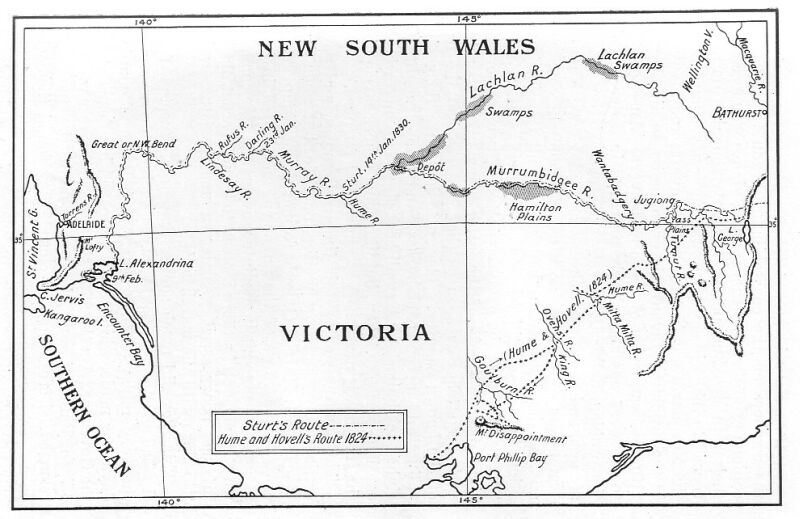
NEW SOUTH WALES. — On November 8, 1824, Hume and Hovell became the first known Europeans to see the Australian Alps. Excited by the sight of the beautiful mountains, Hume wrote in his journal, “… a prospect came into view the most magnificent, this was an immence [sic] high Mountain Covered nearly one fourth of the way down with snow, and the Sun shining upon it gave it a most brilliant appearance.”
Although the two men argued for most of their journey, and even for many years after their return, the expedition was successful in many ways. Hume and Hovell were the first to discover the “Hume River”, though it was later renamed by Sturt as the Murray River.
Hamilton Hume, born near Parramatta on June 19, 1797, was an Australian-born settler with excellent bush skills. He developed an interest in exploring when he was sent by Governor Macquarie in 1818 to find an overland route south from Sydney to Jervis Bay. On this occasion, accompanied by ex-convict James Meehan, Hume discovered the rich, fertile land of the Goulburn Plains.
As a grazier, Hume was interested in exploring south of the known Sydney area to open up new areas of land, but could not gain Government support for his proposed venture.
William Hovell was an English immigrant with little bush experience, a former ship’s captain who was keen to assist Hume’s expedition financially, and accompany him. The expedition was set up, and Hume and Hovell departed Hume’s father’s farm at Appin, southwest of Sydney, in early October 1824.