
BY PETER GRESTE for THE CONVERSATION with ASHLEY GEELAN
CARTOON BY CLAY JONES
The video of a Los Angeles police officer shooting a rubber bullet at Australian Channel Nine reporter Lauren Tomasi is as shocking as it is revealing.
In her live broadcast, Tomasi is standing to the side of a rank of police in riot gear.
Channel Nine Australia is affiliated with CNN in the United States.
She describes the way they have begun firing rubber bullets to disperse protesters angry with US President Donald Trump’s crackdown on illegal immigrants.
As Tomasi finishes her sentence, the camera pans to the left, just in time to catch the officer raising his gun and firing a non-lethal round into her leg. She said a day later she is sore, but otherwise OK.
The officer purposefully took aim and directed his gunshot at Tomasi concluded her ‘piece to camera’ and turned her back. The officer, believed to be an LAPD police officer, waited until Tomasi had turned her back, lined her up, and then shot at her. A cowardly act.
Even the American ‘gunslingers’ of the ‘Wild West’ movies at least shot each other face to face.
Many other journalists and photo journalists in the United States are reported by many media outlets of similar incidents, which appear to be growing across the United States.
Although a more thorough investigation might find mitigating circumstances, from the video evidence, it is hard to dismiss the shot as “crossfire”. The reporter and cameraman were off to one side of the police, clearly identified and working legitimately.
The shooting is also not a one-off. Since the protests against Trump’s mass deportation policy began three days ago, a reporter with the LA Daily News and a freelance journalist have been hit with pepper balls and tear gas.
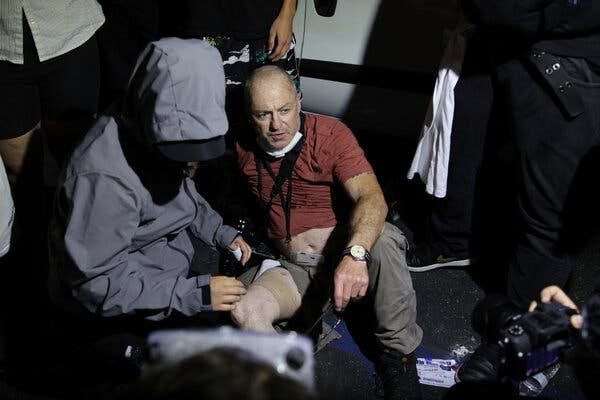
British freelance photojournalist Nick Stern also had emergency surgery to remove a three-inch plastic bullet from his leg.
In all, the Los Angeles Press Club has documented more than 30 incidents of obstruction and attacks on journalists during the protests.
Trump’s assault on the media
It now seems assaults on the media are no longer confined to war zones or despotic regimes. They are happening in American cities, in broad daylight, often at the hands of those tasked with upholding the law.
But violence is only one piece of the picture. In the nearly five months since taking office, the Trump administration has moved to defund public broadcasters, curtail access to information and undermine the credibility of independent media.
International services once used to project democratic values and American soft power around the world, such as Voice of America, Radio Free Europe and Radio Free Asia, have all had their funding cut and been threatened with closure. (The Voice of America website is still operational but hasn’t been updated since mid-March, with one headline on the front page reading “Vatican: Francis stable, out of ‘imminent danger’ of death”).
The Associated Press, one of the most respected and important news agencies in the world, has been restricted from its access to the White House and covering Trump. The reason? It decided to defy Trump’s directive to change the name of the Gulf of Mexico to Gulf of America.
Even broadcast licenses for major US networks, such as ABC, NBC and CBS, have been publicly threatened – a signal to editors and executives that political loyalty might soon outweigh journalistic integrity.
The Committee to Protect Journalists is more used to condemning attacks on the media in places like Russia. However, in April, it issued a report headlined: “Alarm bells: Trump’s first 100 days ramp up fear for the press, democracy”.
A requirement for peace
Why does this matter? The success of American democracy has never depended on unity or even civility. It has depended on scrutiny. A system where power is challenged, not flattered.
The First Amendment to the US Constitution, which protects freedom of speech – has long been considered the gold standard for building the institutions of free press and free expression. That only works when journalism is protected – not in theory but in practice.
Now, strikingly, the language once reserved for autocracies and failed states has begun to appear in assessments of the US. Civicus, which tracks declining democracies around the world, recently put the US on its watchlist, alongside the Democratic Republic of Congo, Italy, Serbia and Pakistan.
The attacks on the journalists in LA are troubling not only for their sake, but for ours. This is about civic architecture. The kind of framework that makes space for disagreement without descending into disorder.
It’s quite clear that mainstream media is kow-towing to US President Trump. This has extra significance for Australia, given that former Australian, now American, Rupert Murdoch controls FOX Newsand affiliates, The Wall Street Journal, The New York Post and a large portion of Australian media too.
Whislt not widely acknowlegded by the mainstream media, what is happening in America has both direct and indirect impacts on all aspects of Australian life.
Let’s not forget, that ‘the Mother Country’ the United Kingdom was too busy in European theatres of war in World War II that it was America that came to Australia’s aid.
Unlike America, we still have a King – an actual one – who in some cirumstances can dismiss the Goverment and call an election. Strangely, this is very thing America was founded on getting rid of.
We’re already at the first verse of “First they came for … ”
Press freedom is not a luxury for peacetime.
It is a requirement for peace. Today.
This article is republished from The Conversation under a Creative Commons license. Read the original article.
Cartoon by Clay Jones of claytoonz. Follow Clay on Bluesky here.