




















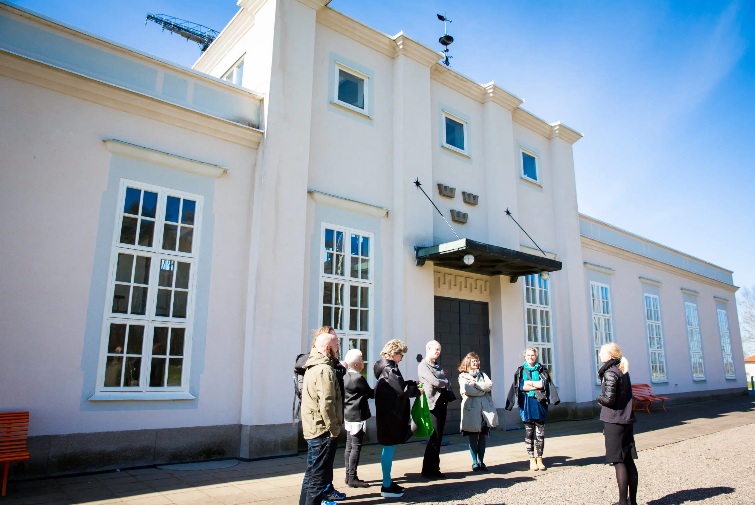
GRIMETON, SWEDEN. — One of the world’s most remarkable pieces of radio history is preparing to come alive again. On Saturday, October 24, 2026, the historic SAQ Grimeton Radio Station in Sweden will transmit a special Morse code message celebrating United Nations Day, promoting peace, unity and international cooperation.
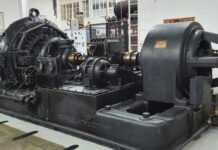
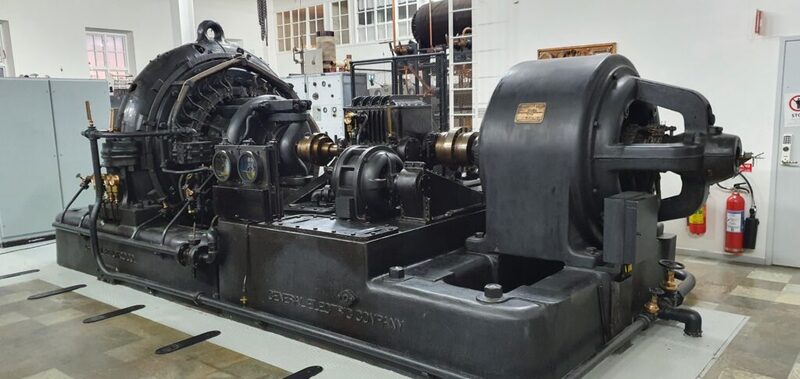
What makes this transmission extraordinary is the equipment producing it. Rather than using modern electronic transmitters, SAQ will operate its original Alexanderson alternator, a remarkable piece of electromechanical engineering dating from the 1920s. The transmission will take place on 17.2 kHz CW (Morse code), deep in the Very Low Frequency (VLF) spectrum, using technology developed more than a century ago.
SAQ was put into commercial radio traffic on December 1, 1924, at first on 16.2 kHz. In mid-December 1924, the frequency was changed to 16.1kHz and on December 24, 1926, it was changed back to 16.2kHz.
On March 10, 1927, SAQ’s frequency was again changed, this time to 17.0kHz, a frequency previously used by Italian station IRC in Rome.
Only two weeks later, on April 3, 1927, SAQ’s frequency was again changed, now to 17.2kHz, a frequency previously occupied by LPV in Buenos Aires, in order to provide a “suitable non-interfering wave channel for new Belgian station ORU Ruysselede”, according to the traffic manager at RCA.
17.2kHz has since then, except for a short period in the 1950’s when SAQ was transmitting on 17.25kHz, been the frequency we all now know belongs to the historical Alexanderson alternator SAQ at Grimeton Radio Station in Sweden.
On United Nations Day, October 24, 2026, SAQ is scheduled to spread a peace message to the World on 17.2kHz CW (Morse code).
Alexanderson would receive a patent in 1911 for his device.
The Alexanderson alternator followed Fessenden’s rotary spark-gap transmitter as the second radio transmitter to be modulated to carry the human voice.
Until the invention of vacuum-tube (valve) oscillators in 1913, such as the Armstrong oscillator, the Alexanderson alternator was an important high-power radio transmitter and allowed amplitude modulation (AM) radio transmission of the human voice.
The outbreak of World War I in 1914 forced European nations to temporarily abandon development of international radio communications networks, while the United States increased efforts to develop transoceanic radio. By the end of the war, the Alexanderson alternator was operating to reliably provide transoceanic radio service.
For radio amateurs, engineers and experimenters, SAQ offers a fascinating connection to the pioneering days of radio. It demonstrates the extraordinary engineering required to generate and radiate VLF signals long before valves, transistors, integrated circuits and software-defined radios became commonplace.
When to Listen in Australia
The Alexander Association has announced the following schedule for Saturday, October 24. Australian Eastern Daylight Time (AEDT) is 11 hours ahead of UTC.
Alternator startup and tuning 12:30pm, Saturday.
SAQ CW identification begins 12:45pm, Saturday.
United Nations Day peace message 13:00am, Sunday, October 25.
All times are scheduled and subject to operational conditions. Queensland is one hour behind AEDT; South Australia is 30 minutes behind.
The station also plans preliminary test transmissions on Friday, October 23, between 11:00 and 14:00 UTC, corresponding to 10:00pm Friday through 1:00am Saturday AEDT.
Can Australian Amateurs Receive SAQ?
Receiving SAQ presents an interesting technical challenge. At 17.2 kHz, the wavelength is approximately 17.4 kilometres, considerably longer than anything encountered on the conventional amateur HF bands.
A suitable VLF receiver or SDR, together with an appropriate receiving antenna, offers an opportunity to experiment with reception. Active magnetic loops and specialised VLF receiving arrangements can be particularly useful, although local electrical noise and propagation conditions may make reception difficult.
For amateurs who cannot receive the VLF signal directly, the Alexander Association will provide a live YouTube broadcast, including the startup and tuning of the alternator, technical commentary and the transmission itself.
The associated amateur radio station SK6SAQ is also scheduled to operate on HF during the event, providing an opportunity for radio amateurs around the world to make contact with the team at Grimeton.
Planned frequencies are:
CW 3.5172 MHz
CW 7.0172 MHz
CW 14.0172 MHz
SSB 3.755 MHz
SSB 7.140 MHz
Two amateur stations are expected to operate for much of the day. These HF transmissions are separate from the historic SAQ transmission on 17.2kHz.
Reception Reports and QSL Cards
The Alexander Association welcomes reception reports from listeners worldwide. For a guaranteed electronic QSL confirmation, listeners should use the official online SAQ reception report form, available from October 24 until November 22, 2026.
Reports submitted by email, ordinary mail or through the bureau may not receive confirmation.
Reports for amateur station SK6SAQ are handled separately.
This is more than a historical demonstration.
It is an opportunity to hear the same fundamental technology that helped establish international wireless communications a century ago, still transmitting a message to the world.
Modern VLF radio transmissions are still used today for military communications with submarines.
A century-old machine, a 17.2kHz Morse code signal and a message of peace.
Radio history doesn’t get much more authentic than this.
The Wireless Institute of Australia (VK1WIA) and the Alexander Association (Sweden) contributed to this report.
The editor of VicNews, Ashley Geelan, is a member of the Wireless Institute of Australia and a licensed amateur radio operator, VK3HAG.