



















Every April 18, Radio Amateurs worldwide take to the airwaves to celebrate World Amateur Radio Day. On this day in 1925, the International Amateur Radio Union (IARU) was formed in Paris.
Amateur radio experimenters were the first to discover that the shortwave spectrum (3- 30 MHz)— far from being a wasteland — could support worldwide propagation.
“World Amateur Radio Day is an opportunity to reflect on our achievements since 1924. We should celebrate our diverse community and the advances and innovations we have made,” an IARU spokesperson told VicNews via amateur radio, ‘on the wires.’
We should take time to reflect on the remarkable achievements of radio amateurs over the last 100 years. While the Amateur Services have been in operation for over a century, 1924 was the first year that intercontinental amateur communication became more or less commonplace.
As reported by Kenneth B. Warner, 1BHW, in the June 1925 edition of QST:
“The International Amateur Radio Union, the dream of years, came into existence on April 17, 1925, when the delegates of twenty-three nations met at the Faculte des Sciences in Paris in the First International Amateur Congress.
“The Union has adopted a constitution, its officers have been elected and four national sections have been formed and recognized. Its objects lie along lines that will promote and co-ordinate two-way radio communication between the amateurs of the various countries of the world. Membership is by individuals, and anyone interested in the objects of the Union can become a member.
In each country from which there are 25 or more members, is there to be a National Section, like divisions in the A.R.R.L., each with its National President and these National Presidents with the Executive Committee, constitute the Board of Directors of the Union. Our A.R.R.L. president, Mr. Hiram Percy Maxim, U1AW, was elected International President.”
You can thank Amateur Radio for broadcast radio, television, space communications, satellite technology, mobile ‘cell’ phones and most of the communications technology we all use today. No billionaires required.
Without Amateur Radio, there’d be no mobile phones, Facebook, Twitter or the internet as we know it today.
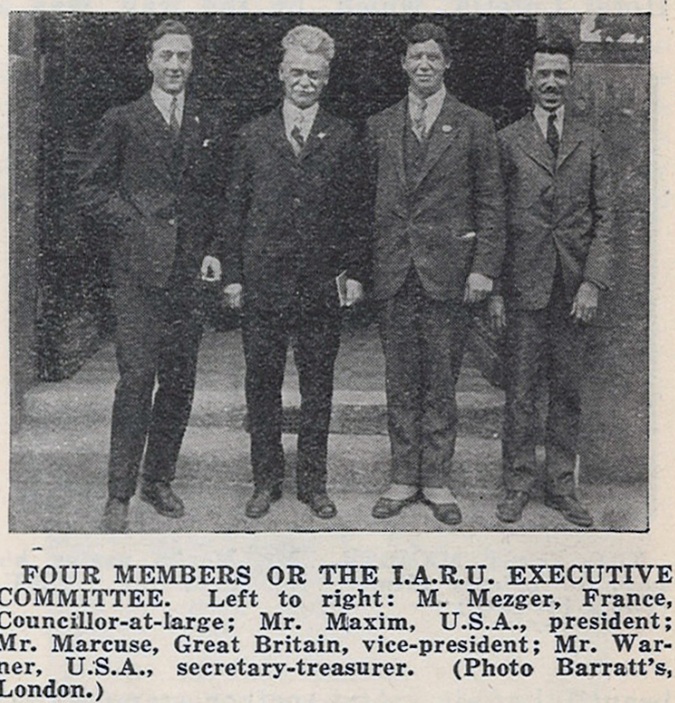
In the rush to use shorter wavelengths in the 1920s, amateur radio was “in grave danger of being pushed aside,” the IARU’s history notes. Amateur Radio pioneers met in Paris in 1925 and created the IARU to support Amateur Radio worldwide.
From the 25 countries that formed the IARU in 1925, the IARU has grown to include 160 member societies in three regions. IARU Region 1 includes Europe, Africa, the Middle East, and Northern Asia.
Region 2 covers the Americas, and Region 3 comprises Australia, New Zealand, the Pacific island nations, and most of Asia. The International Telecommunication Union (ITU) – part of the UN – has recognised the IARU as representing the interests of Amateur Radio.
Australia’s Wireless Institute of Australia (WIA) is a member of IARU Region 3, which manages radio spectrum use for amateurs and other radio spectrum users, in the Asia-Pacific region.
Here’s to another 100 Years of IARU and Amateur Radio, world leaders in science, technology, engineering and maths (STEM) that even NASA rely on.
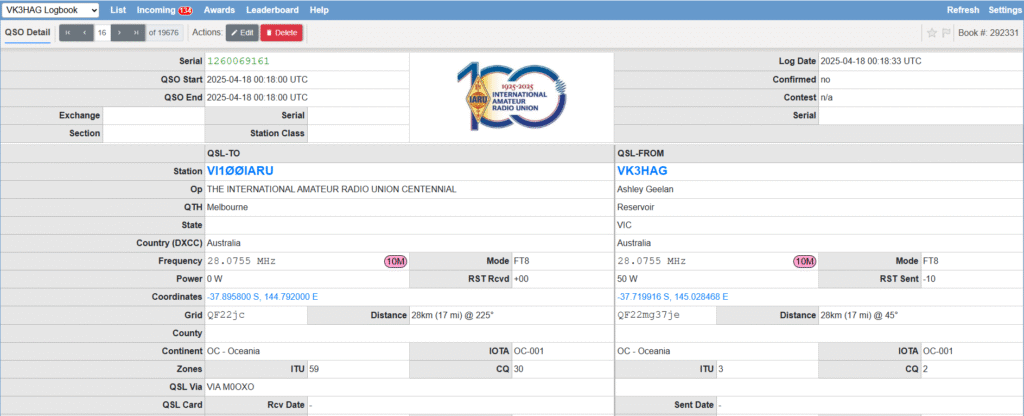
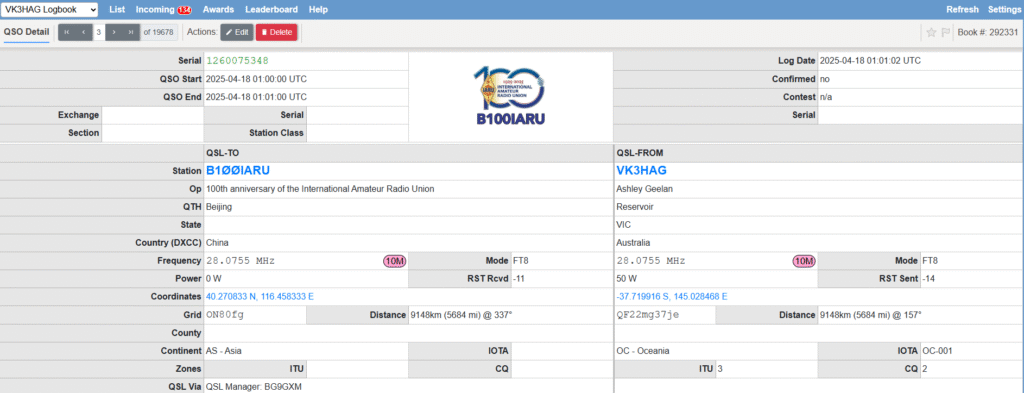
When All Else Fails. Ham Radio Works.
– With IARU, ARRL & WIA.
The author, Ashley Geelan, VK3HAG, the owner of this masthead, is an Australian (VK) Amateur Radio operator.