













Amateur radio operators – commonly called ‘hams’ – in Australia will play a small but important part in receiving pictures from the first space flight in polar orbit.
The history-making Fram2 mission, the first crewed space flight aiming to orbit Earth over the north and south poles, launched from Cape Canaveral, Florida, on Tuesday (UTC/GMT).
You can watch live here.
A unique radio experiment is being planned by the amateur radio club of Technische Universität Berlin (AFuTUB).
On April 1, 2025, TU Berlin alumna Rabea Rogge, who will be the first German woman to launch into space, plans to make contact with Earth – directly from a SpaceX Dragon spacecraft in orbit. This is a milestone for German space travel. A TU Berlin livestream will broadcast the event directly from the University’s radio room.
For more information: https://idw-online.de/en/news849915
The radio contact with Rabea Rogge is currently scheduled for April 1, 2025, starting at 09:28 AM. The livestream will begin at 09:20 AM (CET)–Berlin time (0720hrs UTC/GMT).
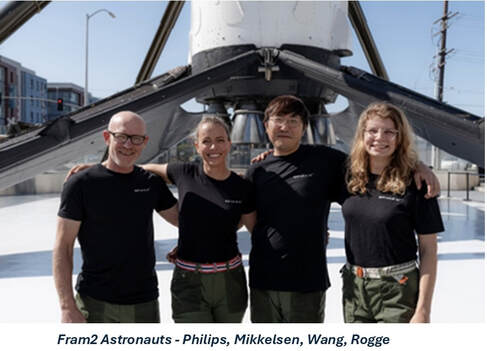
Among the four astronauts is Australian polar adventurer Eric Philips, making him the fourth Australian in space and the first Space X astronaut.
Amateur, or “ham”, radio operators are now waiting for the Dragon capsule to make the first of several passes over Australia so they can receive live via VHF/UHF radio (144MHz/430MHz) the slow-scan television (SSTV) pictures.
The images will be used in a worldwide amateur radio competition to encourage the next generation of space and radio enthusiasts.
Connecting to SpaceX capsule
At his home in central Queensland, Shane Lynd, VK4ISS has an impressive array of antennas, amplifiers, transmitters and radio receivers.
He is part of the worldwide Amateur Radio on the International Space Station (ARISS) network that will download images for the competition.
Once computer software indicates his base station in Mackay has acquired a signal from Fram2, Mr Lynd will listen for the tell-tale sounds the capsule is transmitting an image.

“They will be transmitting what’s basically a single frame video picture as the capsule passes over Australia and the idea is to try and decode that,” he said.
“They’re basically like photographs but when you listen to the data with the raw ear it sounds a bit like musical tones.
“We have some smart software which decodes the compressed data and transforms it into an image like a photo.”
SSTV was used to transmit the first images of the moon to earth during the first lunar landing.
SSTV converts ‘noises on a radio’ (like dial-up internet) and these noises carry data from the radio’s audio or speaker/headphone output to the computers ‘mic’ or ‘audio in’ and software, such as MMSSTV is used to convert the noises to a still image.

Ham radio operators are hoping to download up to three images during each pass, which could last up to 10 minutes from horizon to horizon.
Each image will take about 26 seconds to decode.
Voice contact may also be possible with two of the astronauts who are licensed ham radio operators.
If Mr Lynd is successful, it won’t be the first time he’s spoken to an astronaut.
He is one of three radio operators in the Australian Amateur Radio on the International Space Station ARISS community, which facilitates contact between ISS astronauts and school groups.

He has had about 80 contacts with the ISS over the past 20 years.
“No two contacts are ever the same and I get an enormous buzz out of each of them,” he said.
“In the build up to each of those contacts, I’ll often walk around, pacing the hallway right up until acquisition of signal.
“You’ll have your 10-minute contact and then just huge relief after it.”
The Fram2 mission
The north and south poles are invisible to astronauts on the ISS and have only been seen from a long distance by the Apollo lunar missions.
Flying at an altitude of 430km, the crew can travel between poles in just over 46 minutes.
Fram to ham
There are about 17,500 licensed amateur radio operators in Australia and many will be downloading images from the mission,
The Fram2 crew will send pictures of three locations that are historically significant in polar exploration.
The images will be cut up like a jigsaw, loaded to a website and competition entrants challenged to identify the Earth location.
Frank Bauer, KA3HDO, an executive director of ARISS in the United States who previously worked for NASA for 40 years in robotic and human spacecraft, said partnering a commercial space crew was a first and was vital if ARISS was to continue linking students with astronauts.
“The space station is ultimately going to retire in a few years and so we’re looking at how we can get involved in the commercial world,” he said.
“This is a great mission because they want to focus on inspiring students to learn about polar history.”
The following frequencies are currently used for Amateur Radio ISS contacts (QSOs):
Voice and SSTV Downlink: 145.80 (Worldwide)
Voice Uplink: 144.49 for ITU Regions 2 and 3 (The Americas, and the Pacific and Southern Asia)
Voice Uplink: 145.20 for ITU Region 1 (Europe, Russia and Africa)
VHF Packet Uplink and Downlink: 145.825 (Worldwide)
UHF Packet Uplink and Downlink: 437.550
VHF/UHF Repeater Uplink: 145.99 (PL 67 Hz)
VHF/UHF Repeater Downlink: 437.80
For a description of ITU regions, consult the ITU map.
Most ARISS operations are split-frequency (each station uses separate receive and transmit frequencies). The downlink is the earth station’s receiving frequency. The uplink is the earth station’s transmitting frequency. Earth stations can listen to the downlink frequency and transmit on the uplink frequency when the ISS is in range and crew members are on the air. Please do not transmit on the ISS downlink frequency.
When All Else Fails. Ham Radio Works.

The owner of this masthead is amateur radio operator, VK3HAG, and is participating in this experiment.
With Danielle Jesser, ABC News Queensland; WIA Queensland; Wireless Institute of Australia (WIA); Australan (VK#) ham radio operators; NASA; AMSAT; TU Berlin; and the International Space Station.